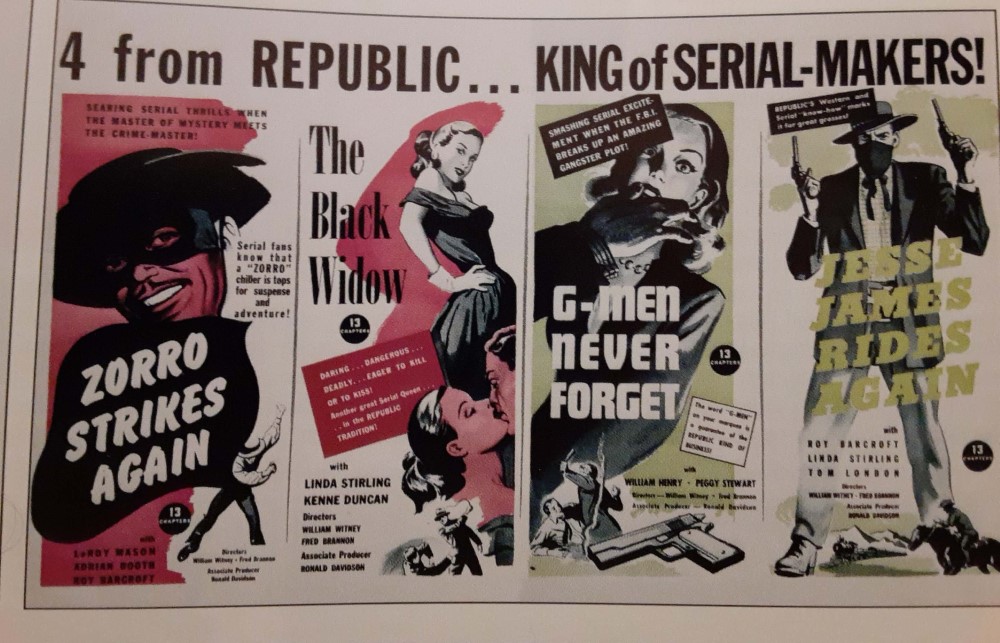
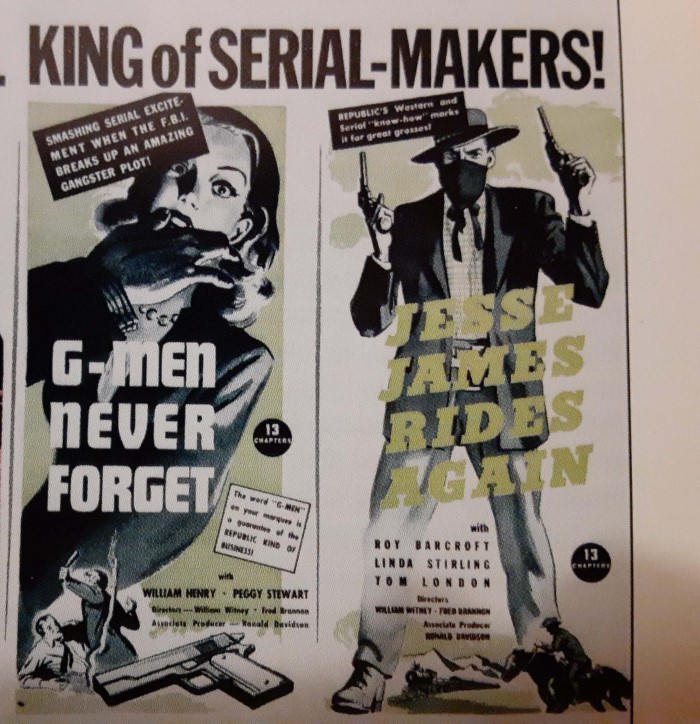
This interesting image was reprinted by Jack Mathis in his book Republic Confidential, Volume 1: The Studio. It’s part of Republic’s 1946-47 Advance Preview Film Program, a publication distributed to exhibitors to sell them on the studio’s planned future projects. As you’ll notice, one of the projected serials underwent a title change between announcement and production–Zorro Strikes Again would eventually become Son of Zorro. That’s not the most interesting thing here, however–take a look at the cast names listed on each “preview” poster. We have LeRoy Mason, Adrian Booth, and Roy Barcroft in Zorro Strikes Again, Linda Stirling and Kenne Duncan in The Black Widow, Bill Henry and Peggy Stewart in G-Men Never Forget, and Roy Barcroft, Linda Stirling, and Tom London in Jesse James Rides Again. Barcroft would be in Zorro Strikes Again when it was eventually released as Son of Zorro, and all three of the listed cast members on the Jesse James poster would actually appear in that serial. The other names listed, however, wound up having nothing to do with the future serials whose posters they appear on (for greater detail, see the enlarged versions below).
It’s fascinating to speculate about prospective casting changes that may have taken place between the drafting of these posters and the actual production of the serials in question, and to ponder about how the serials in question might have turned out differently had the originally announced actors appeared in them (for example, I doubt G-Men Never Forget would have felt as distinctively hard-boiled as it did had the cheerful, clean-cut Bill Henry and the wholesomely outdoorsy Peggy Stewart played the leads as opposed to the grim, intense Clayton Moore and the sultry and sophisticated Ramsay Ames, who of course actually starred in the finished serial). However, fun as such speculation is, it’s actually my belief that none of these people were ever necessarily slated to appear in these serials at the time the preview program was released. Note that every actor whose name appears on the poster was under a Term Player contract to Republic; Term Players were required to appear in every film they were assigned to, so my suspicion is that Republic simply plugged in, as placeholders, the names of actors whom the studio knew would be available when they issued this advertisement to exhibitors, wanting to avoid committing to the names of any freelancers whom they might not be able to sign. The studio rarely cast its heroes from the ranks of its Term Players, which is probably why the names of any leading men are absent from all the posters (except the G-Men Never Forget one); it’s highly unlikely that Kenne Duncan was ever even considered to play the male lead in Black Widow, or Roy Barcroft the title role in Jesse James Rides Again.
It’s also interesting to note how little at least two of the posters have to do with the serials they represent, making me suspect that no scripts or story outlines existed when the preview program came out. Zorro on the Zorro Strikes Again poster is wearing the classic Douglas Fairbanks mask, not the full face-concealing masks favored by Republic’s Zorros (the hero of Son of Zorro included), and the figure at the bottom of the poster looks like a contemporary thug, not a Spanish bandit or Western outlaw. This modern-looking henchman, taken together with the blurb at the top, “Searing Serial Thrills When the Master of Mystery Meets the Crime-Master!” seems to suggest that this Zorro will be taking on a master criminal in the present day, not in Old California or the Wild West–which, of course, did not happen in Son of Zorro, which was a standard period Western. Similarly, the “Black Widow” on the eponymous poster is not only drawn much more seductively and glamorously (she’s wearing gloves, even) than any actual female character in a Republic serial, but is also apparently touted as the protagonist (“Another great Serial Queen…in the Republic Tradition!”), even though the immediately preceding lines make her sound at least a little more like the antagonist we saw in the finished serial (“Daring…Dangerous…Deadly…Eager to Kill…or to Kiss!”)–minus, of course, any kissing stuff.
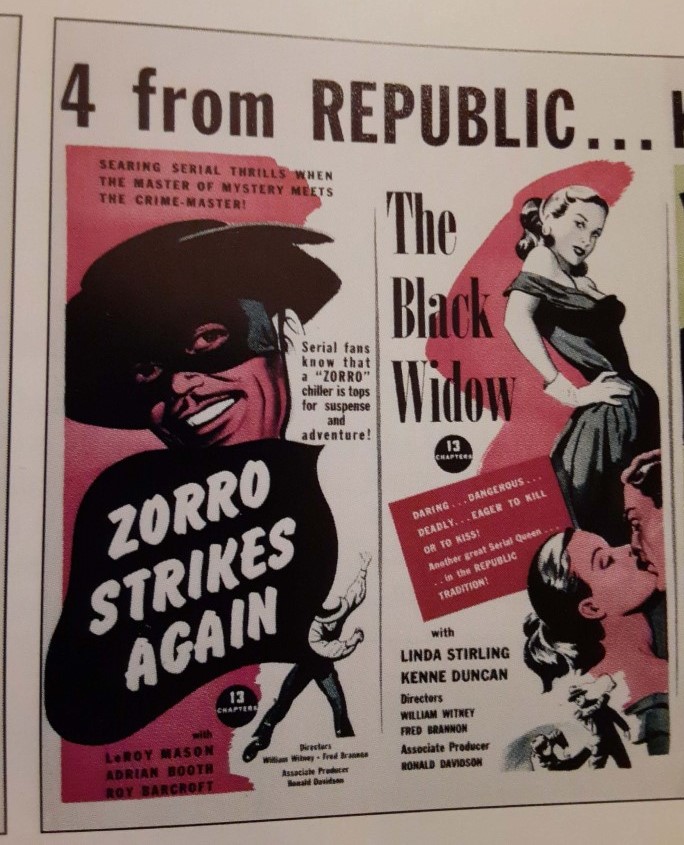
Looking below the cast names to the producer/director credits, note that all four serials are slated to be directed by William Witney and Fred Brannon, the team responsible for Republic’s previous serial, The Crimson Ghost; of course, Son of Zorro and The Black Widow wound up being directed by Spencer Bennet and Brannon instead, while G-Men Never Forget would be helmed by Brannon and Yakima Canutt, and Jesse James Rides Again by Brannon and Thomas Carr. The absence of Bennet’s name on any of the posters makes me wonder if Republic had initially decided to let him go entirely at the end of 1946 when Witney returned from World War 2, then briefly called him back when the studio decided to move Witney over to the Roy Rogers B-western unit instead. Finally, observe that Ronald Davidson, who had been producing Republic’s serials since 1944, is credited as producer; between the issuance of the program and the actual making of these serials, he would be replaced by Mike Frankovich.
 The Files of Jerry Blake
Another excellent entry. Thank you.
These posters are extremely interesting, and give some real insight into Republic’s different marketing strategies. In particular, the one for “Black Widow” seems designed to appeal to a much more sophisticated audience than might typically be the target group for one of their chapter plays. Your speculation regarding the use of actors under “Term Player” contracts as placeholder entries certainly makes sense, as do the “Witney instead of Bennet” comments. Imagine how different these films might have been with Witney at the helm.
It’s also an interesting coincidence that the face depicted in the “Zorro” poster bears (at least to my eye) a more than passing resemblance to Guy Williams, who later played the character in the Disney adaptation. There’s no connection between the two productions other than the title hero, but it caught my eye.
I’m always happy when another Serial Scrapbook post shows up, in this case a pair of behind-the-scenes peeks at the promotion of future serials to theater owners.
A couple of interesting (to me, anyway) details is that the 4 serials advertised here are all described as 13-chapter serials. Another is that LeRoy Mason, Adrian Booth, and Roy Barcroft did all appear together in Daughter of Don Q.
Any posts that offer a glimpse of the “what might have beens” like The Fighting General, The Adventures of Daniel Boone, Pirate Gold, The Fu Manchu sequel, Roy Rogers as Robin Hood, Phantom of the Race Track, and Return of the Scarlet Horseman (the sequel not requested by popular demand) always interest this serial fan who was born after the heyday of the Saturday matinee and only got to see one chapter of Commando Cody, Sky Marshal of the Universe in an actual movie theater.
May I say that if you have not perused earlier posts from before the time you discovered this gem of a website, do so. You won’t regret it.
Great comment. Until you mentioned it, I didn’t notice the advertised reference to the 13-chapter format for the four serials. Three of the four would actually be made with 13 chapters; only “G-Men Never Forget” would revert to the more standard 12 chapters. Republic did four 13-chapter serials, all coming in 1947-48. All the rest of the productions in their history were either 12 or 15 chapters. I wonder what motivated them to add the extra chapter during this time frame. I know Universal often utilized 13 chapters, but they were out of the serial business by 1947, so it doesn’t seem to have been competition with them that drove the move. It would interesting to know more about the decision.
Thanks! Honestly, I hadn’t remembered that Republic did, in fact, do 13-chapter serials. Other than the 14-chapter “Robinson Crusoe of Clipper Island”, I only recalled the 12- and 15-chapter ones.
In fact, my first encounter with a 15-chapter serial was as an 8-year-old in the mid-50s watching one chapter a week of 12-chapter 1930s Mascot serials as part of a 2-hour Saturday morning cartoon show. As I watched Chapter 12 of “The Miracle Rider”, I began wondering why it didn’t seem to be wrapping up with the capture of Zaroff. I was shocked–shocked, I tell you!–to see another cliffhanger ending. The next week … Chapter 13, and another cliffhanger ending, and the title of Chapter 14! By this point, I had the bright idea to read the title screen the next week to see just how many chapters there were.
Now I’d like to know whether individual theaters could choose to rent their next serial from any of the studios or whether they were locked into (or given) the “exclusive” right to show one studio’s serials, whether serials were distributed to larger markets first and then offered to smaller markets, and–to anyone who did see their serials at Saturday matinees–whether more than one theater in a city hosted Saturday matinee performances, but with different serials.
I would like to see the program for 1943-44 to see if CAPTAIN AMERICA was mentioned. One fan states as fact that it was originally supposed to be a MR. SCARLETT serial. That would put an end to that nonsense.
There’s a great article at the “Old Corral” website entitled “Poverty Row and the B-Western Producer” which covers many of the economic and logistical aspects of film distribution during the 1930’s and 1940’s. (It’s listed under Section 10, Ramblings and Writings.) Although it focuses primarily on westerns and doesn’t discuss serials per se, I would imagine that much of the information regarding exhibitors, distribution deals, rental fees, etc is probably also applicable to the chapter play genre. It makes for very interesting reading.
Happy to receive any and all posts and messages from you!