Mascot, 10 Chapters, 1929. Starring Walter Miller, Jacqueline Logan, Boris Karloff, Larry Steers, Richard Neill, Harry Todd.
A gang of jungle outlaws led by “Scarface” Macklin (Boris Karloff) have made their headquarters in the ruined lost city of Nuhalla, deep in the African jungle; from this base, they launch raids against ivory safaris, aided by a preternaturally intelligent gorilla. Larry Trent (Walter Miller), a Secret Service agent, is dispatched to run down the gang and their simian ally; three of his predecessors have disappeared while on the same errand, the last of them being Larry’s own brother. In the course of his investigations, Larry comes upon a map to the fabled lost jewels of Nuhalla, which are also being sought by Macklin’s gang. He joins forces with Diana Martin (Jacqueline Logan), who has been raised by the local priest with the aid of annual payments from her unknown father; Diana is also seeking Nuhalla, where she hopes to find a clue to her mysterious parent. Together, she and Larry brave the dangers posed by Macklin and his gang, by Macklin’s duplicitous trader accomplice Drake (Larry Steers), and by the fearsome gorilla, who is known locally as The King of the Kongo.
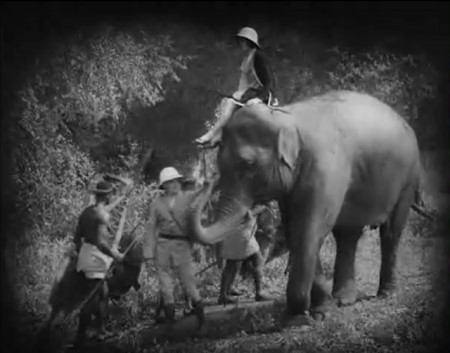
Above: Walter Miller and Jacqueline Logan on safari.
Universal’s The Indians Are Coming was the first all-talking serial, but The King of the Kongo was the first serial to feature talking scenes; each episode includes at least two full-sound dialogue sequences, while subtitles are used in other scenes and sound effects are scattered throughout the serial. Since the sound was recorded on separate discs which were subsequently lost, the serial for many years survived only in fully silent prints. Film restorationist Eric Grayson has reassembled all the surviving sound discs and has put together a pristine, beautifully restored new DVD/Blu-Ray print which returns the serial to its original hybridized form; a few of the sound portions remain lost, but they have been recreated by means of dubbing. Like most such dubbing efforts, the new voices are only indifferent recreations of the old voices, but they’re entirely competent, and I appreciate the fact that the dubbers attempt to duplicate the measured delivery of the original early-talkie actors; so many latter-day dubbing attempts jar because the dubbers’ rapid modern cadences don’t match the more deliberate diction of older performers.
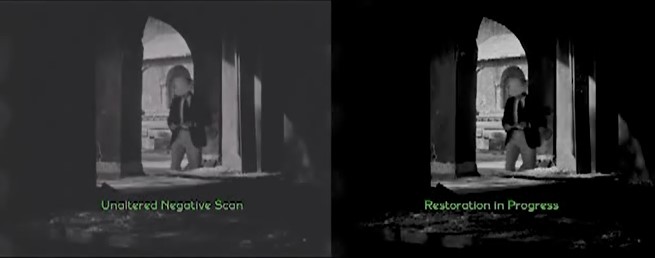
Above: A comparison between the original and the restored prints of King of the Kongo, provided by Eric Grayson as a bonus on the DVD.
So, the restoration work is excellent on the whole; what about the serial itself? As one would expect considering the then-novel sound filming, dialogue is sometimes awkward, some dialogue delivery is stilted, and the cinematography in the talking scenes is understandably static—although the camera, in usual Mascot style, is quite fluid and often striking during non-dialogue sequences, with Ray Ries and future Oscar-winner Ernest Laszlo ably handling cinematographic duties. Overall, the serial is more than respectable, technically speaking; Mascot boss Nat Levine obviously did not want to skimp too much on production value for this inaugural venture into a new film medium. Levine’s budget-consciousness still shows, however, in the strategic placement of one of the serial’s selling points, live wild animals, almost entirely in the first three chapters, which would have been the samples shown to exhibitors; there are a few additional appearances by lions in later episodes, but the elephant that functions as the as the heroine’s trusty ally in the first two chapters and the lively leopards that threaten the hero and heroine in Chapters One and Three take no further part in the action, except for a brief reappearance by a leopard which is passed off as the villains’ trained carrier cheetah.

Above left: A striking downwards shot of henchmen swarming Walter Miller after his fall through a trapdoor. Above right: A lion races down a stairway in Nuhalla. Click to enlarge either picture.
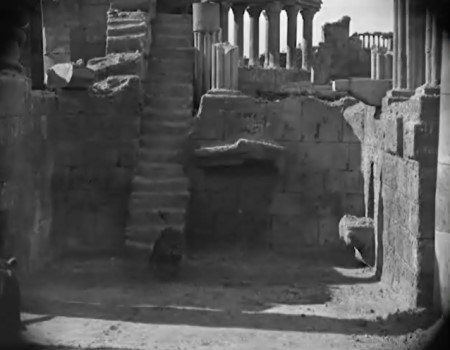
The backdrop to most of the serial’s action, the city of Nuhalla, provides production value throughout the episode, not just in the early episodes; some of the city consists of large full-scale sets, while apparent miniatures and external shots of Angkor Wat in Thailand are used to depict other parts of the city. The opening credits claim that the lost city scenes were filmed in Angkor, but I find this very hard to believe; not even the major studios were engaging in globe-trotting location filming at this point in movie history, let alone a little outfit like Mascot. At most, I would suspect Levine sent a second unit to film exteriors at Angkor; some of the long shots of characters scaling walls or trotting up and down steps in the city look as if the humans have been matted into the picture. Matte work is definitely used, together with a split-screen effect and miniature sets, in the recurring sequences showcasing the giant lizard (an alleged “dinosaur”) that lives in Nuhalla. The effect works quite well in the multiple scenes in which the beast pops up to scare treasure-hunters; however, the monster disappointingly has little to do in terms of the actual plot.

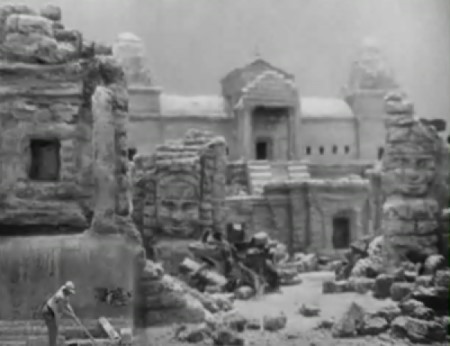
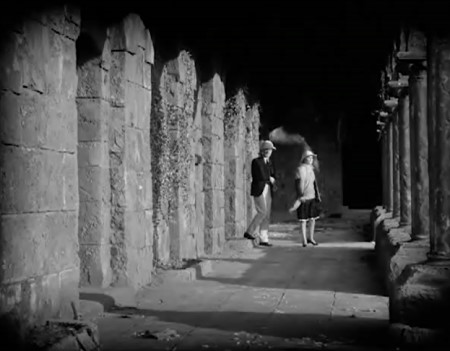

Above, top left: Gordon Russell slinks into a back door at Nuhalla, in what appears to be an example of matte work. Top right: The “dinosaur” of Nuhalla prepares to surprise William Bert. Bottom left: Larry Steers and Jacqueline Logan explore an impressive colonnade at Nuhalla. Bottom right: Steers clambers up a set of steps within the lost city. Click to enlarge any of these images.
As is usual at Mascot, plotting is the weakest element in King of the Kongo. The screenplay, by William Presley Burt (credited with “continuity”) and popular Western novelist Harry Sinclair Drago (“story, titles, and dialogue”), has barely enough material even for its modest ten-chapter runtime, with the narrative mostly devolving into a tug-of-war over the map that shows the way to the jewels of Nuhalla and the accompanying captures and escapes. Despite this fairly simple storyline, the writers manage to incorporate some of Mascot’s usual confusing plot twists into the story, most noticeably in the handling of the character of the Commodore, a quirky derelict who hangs around the local trading post and alternates between helping and hindering the good guys; the ultimate “explanation” of his involvement fails to explain, and in fact contradicts, several of his earlier actions. The revelation concerning the gorilla in the final chapter also leaves a lot of unanswered questions, although in retrospect it is foreshadowed in a couple of earlier scenes—and also gives rise to such a memorably bizarre confrontation between the sinister simian and one of its erstwhile colleagues as to make this plot twist pretty entertaining, albeit disorienting.

Above: Enter the gorilla. According to the late Raymond William Stedman, the ape was played by strongman and silent-serial star Joe Bonomo; Eric Grayson has confirmed that Bonomo identified himself as the gorilla in an interview.
Despite the repetitive and sometimes illogical nature of the plotting, Kongo does benefit from having several solid emotional beats to its storyline. Diana Martin’s quest for her long-lost father is not the perfunctory excuse for the heroine’s participation in the action that it would be in later serials; instead, it is emphasized throughout the serial, and generates some genuine pathos, as she presses the Padre for more information or urges Trent to take her back to Nuhalla to search for clues to her parent. As for that parent, although Burt and Drago try to make his identity mysterious, they also make it evident fairly early on that Scarface Macklin is Diana’s father, which gives rise to some additional emotional depth as the villain tries to carry out his schemes while simultaneously protecting his daughter. The developing affection between Trent and Diana, the slimy Drake’s dishonorable designs on the girl, and Trent’s desire to either find or avenge his brother, provide further personal touches that prevent the characters from becoming the likable but personality-free automatons seen in so many latter-day chapterplays. The penultimate scene, involving Trent, Diana, Macklin, and the Padre, is genuinely moving.

Above: Jacqueline Logan beseeches a conflicted Boris Karloff to give her a clue to her father’s identity.
The remote jungle setting of Kongo precludes the wide variety of on-location action scenes seen in Levine’s stateside chapterplays, but director Richard Thorpe and stuntman Yakima Canutt still stage some good fights and chases, particularly the lengthy clash between Miller (doubled by Canutt) and Karloff (presumably also doubled, though I’m not sure by who) in Chapter Six, which takes them all the way down an enormous set of stairs in Nuhalla and to the edge of a lion pit. The chase sequence in Chapter Seven, with Miller racing around Nuhalla, strategically climbing and hiding as he evades henchmen, is also an entertaining and characteristic Mascot setpiece. Other memorable pieces of action include the Chapter Two sequence that has Miller and Jacqueline Logan encountering a leopard on a ledge above an alligator pit , their ensuing rescue by the elephant at the beginning of the next episode, and the Chapter Three scene that has them escaping some leopards only to run inside a courtyard filled with lions. The anything-goes, what’s-next quality of these animal sequences nicely epitomizes the type of adventurous chaos that is such an enjoyable hallmark of Mascot’s serials.
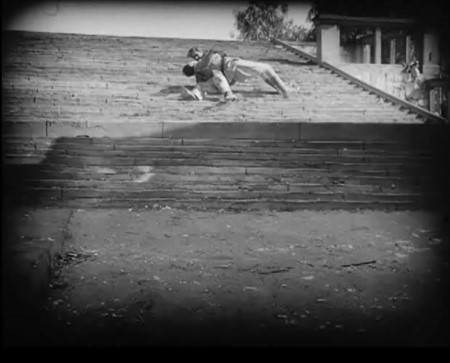
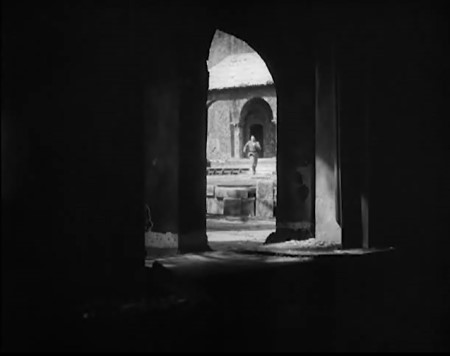
Above left: Hero and villain tussle their way down a staircase at Nuhalla. Above right: Walter Miller races through the city, with henchmen on his trail. Click to enlarge either picture.
All the scenes referenced above culminate in good chapter endings, although the Chapter Six cliffhanger is unfortunately resolved by a cheat, while other chapter endings, like the shooting in the darkened room that concludes Chapter Eight, come close to cheating but don’t quite cross the line. The memorable double cliffhanger of Chapter One, with Miller being attacked by a lion in a pit and Logan being jumped by a leopard, does not have a cheat resolution, although the leopard half of the cliffhanger is resolved pretty improbably. The ending of Chapter Seven, with Miller being buried beneath falling masonry following an explosion in Nuhalla, is the most striking of the non-animal cliffhangers.

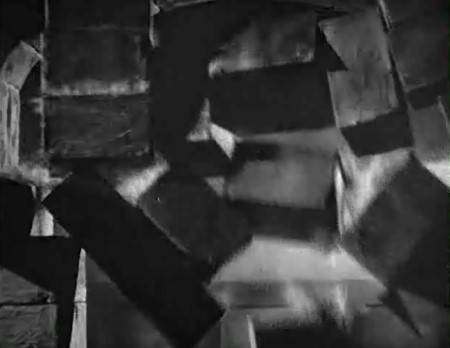
Above: Walter Miller unwittingly triggers the masonry fall at the end of Chapter Seven.
The lion in the Chapter One pit-fight sequence and a shorter later sequence is almost certainly Melvin Koontz’s talented and gentle Jackie, since he’s seen directly interacting with his human co-star; the leopard in Chapter One is likely one of Olga Celeste’s animals. Koontz doubtlessly did the doubling in the lion scenes, and Celeste was probably Logan’s double in the leopard scene. As mentioned, Yakima Canutt does stunt duty at other points in the serial.


Above left: The lion is literally on the hero’s heels at the end of Chapter One. Above right: The leopard enters to bedevil the hero and heroine in Chapter Two. Click to enlarge either image.
The serial’s cast can be noticed struggling with sound technology at several points, but all the players are good ones, and deliver very effective performances considering the transitional filming circumstances. Walter Miller, who would quickly become an adept talkie actor, is his familiar sound-era self in most scenes, rattling off dialogue tersely and authoritatively, with compelling earnestness and energy; he reacts with proper alarm or fury in tense moments, and does a particularly good job conveying dogged determined in his quest to find his brother and smash the criminal gang. However, he does lapse into excessively stilted and declamatory delivery on occasion, particularly in Chapter Two, when he declares himself “more determined than evah” to press on to Nuhalla.
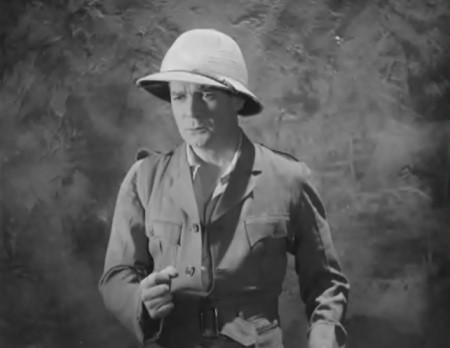
Above: Walter Miller has just found the badge of his missing brother.
Jacqueline Logan, a stage actress and former star of silent features who receives top billing (probably because of her high-profile turn as Mary Magdalen in Cecil DeMille’s silent epic King of Kings) is more consistently comfortable with delivering her lines than Miller is; she’s fervently dramatic at times, but the emotional aspects of her role call for emotional delivery, and her ferventness thus seems entirely appropriate. She does look rather ridiculous running around the jungle, and even scaling walls, in heels and a fashionable 1920s frock, but that’s the fault of the production crew; Levine appears to have been determined to play up her movie-star glamor, since the serial also features a bizarrely incongruous theme song, “Love Thoughts of You,” warbled over the opening credits of each episode and “dedicated” to Logan.

Above: Jacqueline Logan appeals to the off-camera Padre for more information on her mysterious parentage.
As Scarface Macklin, Boris Karloff is already demonstrating the arresting screen presence that would make him famous in a few years; his character is both a brains heavy and an action heavy, and he conveys both the craftiness and the swaggering self-confidence required for the role, convincingly dominating his grumbling henchmen. He’s also able to switch from wily and confident villainy to regret and even pathos when the story requires it, especially in his final scene, and in the earlier scene in which he talks with Logan about her father and views her baby picture.
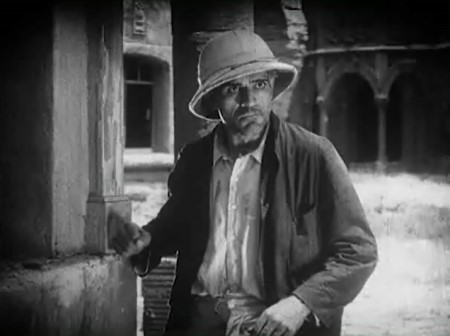
Above: Boris Karloff sees his gorilla cohort getting out of line.
Larry Steers, a former leading man, is well cast as the double-dealing trader Drake; he’s jaunty and handsome enough to make his deception of the good guys credible, but also slick and smug enough to make him a convincing villain. His slippery, oily demeanor also makes him a good contrast to the gruffer and more straightforwardly villainous Karloff.

Above: Larry Steers (arm in sling) condescends to the henchmen. Gordon Russell is facing Steers, and William Bert is behind Russell.
Richard Neill, who was so outrageously hammy as the villain in the 1932 serial The Last Frontier, plays things much more soberly as the unkempt prisoner in the Nuhalla dungeon, giving the role an appropriate combination of desperation and determined resourcefulness. J. P. Lockney is fatherly and kindly as Padre Ricardo, somewhat stagy but not nearly as grandiose as someone like William Farnum would have been, while Lafe McKee manages an entertaining combination of dignity and shiftiness as the questionable trading-post proprietor Trader John. Harry Todd, as the irritatingly underexplained Commodore, plays the part in the overbroad tradition of most of Mascot’s comedy-relief characters, but isn’t particularly obnoxious and doesn’t overdo things nearly as much as he did in his ostensibly straighter role in the contemporary independent serial Sign of the Wolf. The suavely dignified Richard Tucker receives third billing but only a single scene as Miller’s Secret Service superior, while a very tall black actor named Robert Frazier is somewhat listless as the friendly chief of the Wahilis. William Bert and Gordon Russell are the two most prominent members of the serial’s henchman pack, with Bert generally surly and rebellious while Russell is dogged and crafty. If the Internet Movie Database is accurate (always doubtful), William Bert the actor is the same person as William Presley Burt, the writer who is credited with the serial’s continuity.

Above: Harry Todd chortles over his own stupidity while Richard Neill looks perplexed.
The much-sought jewels of Nuhalla, which eventually wind up in a museum at the serial’s conclusion, provide an apposite metaphor, in retrospect, for the serial itself. Like the jewels, The King of the Kongo is something of a museum piece of primary interest to collectors and historians, its hybrid talkie/silent form combining with typical Mascot plotting flaws to make it probably even less accessible to causal viewers than the Mascot efforts of even a few years later. However, it’s also a treasure worth seeking, for anyone who appreciates the world of Mascot chapterplays and is interested in seeing that world at the dawn of the sound era.

 The Files of Jerry Blake
It’s been quite awhile since the last update, and this new review is certainly a great addition to the website. As always, you effectively summarize all the important aspects of the film into a very enjoyable article. I also liked your inclusion of the feature that allows the reader to enlarge the still images. It’s a nice additional touch.
I very much admire Mr. Grayson’s amazing dedication to the task of restoring the serial. I’ve only seen the trailer, but the quality of the picture looks fantastic compared to the previously available prints. Whether or not I’ll actually spring for a copy is hard to say. Despite the presence of Karloff and Miller and the fact that it’s an early Mascot film, I don’t care much for the “jungle-based” stories of this era. Not being a film collector but just a fan of the serial genre, once you get past the historical aspect I doubt that this would be one that would lend itself to multiple viewings.